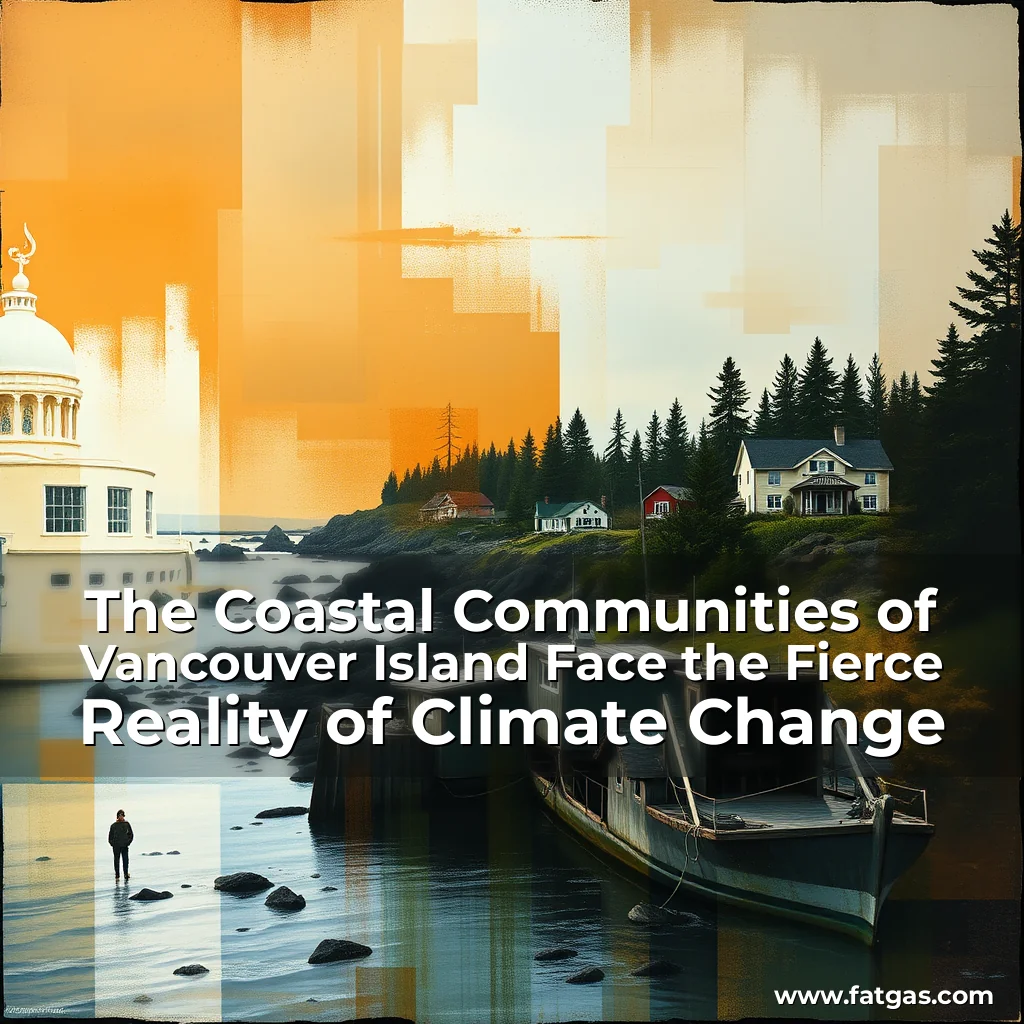
This reality is stark. Rising sea levels, more intense storms, and eroding shorelines are no longer distant threats — they’re happening now. The ocean has always been part of Jan Peterson’s life — the scent of salt air, the crash of waves against the rocky shore. These were constants.
The Accelerating Impacts of Climate Change
From Victoria’s Inner Harbour to Port Hardy, coastal communities on Vancouver Island are confronting the accelerating impacts of climate change. Coastal First Nations are among the most affected by rising seas — and also among the most proactive in preparing for them.
- On eastern Vancouver Island, the Snuneymuxw First Nation is developing a climate adaptation plan that includes restoring degraded shoreline areas and using traditional ecological knowledge to reinforce natural flood barriers.
- Further north, Kwakwaka’wakw communities near Alert Bay are mapping flood-prone zones and advocating for provincial and federal support to relocate critical infrastructure.
Infrastructure at Risk
Lokman notes that sea-level rise is already affecting vital infrastructure, coastal ecosystems, and community livelihoods. According to the Capital Regional District, Oak Bay faces the highest sea-level rise risk on Vancouver Island. With more than 20 kilometres of shoreline and much of it just one to five metres above sea level, the community sits on the climate crisis front line.
| Community | Sea-level Rise Risk | Estimated Damage by 2100 |
|---|---|---|
| Oak Bay | High | $330 million |
| Courtenay | High | $150 million |
| Campbell River | High | $80 million |
Funding Gaps Persist
Some Island municipalities have begun to adapt. Sidney has reinforced parts of its seawall. Courtenay is investing in natural flood defences like wetland restoration. Parksville has updated its floodplain maps to guide safer development.
- Developers continue to obtain variances that allow construction in high-risk areas.
- Most flood-related regulations apply only to new developments, leaving older homes and infrastructure dangerously exposed.
Insurance Pressures Rise
Residents in flood-prone zones are already experiencing financial stress. Property values in some coastal areas have stagnated. Insurance premiums are rising. In some cases, companies have stopped offering flood coverage altogether.
- Property values in B.C. have stagnated.
- Home insurance rates rose 7–8 per cent in 2023 — well above inflation.
- Insurers are passing costs on to homeowners.
The Need for Urgency
James of the Geological Survey of Canada says that while B.C. is taking action at every level, the scale of the challenge requires more urgency.
“We’ve seen a lot of positive momentum, but we’re not where we need to be. The sea doesn’t care about jurisdictional boundaries. We need coordinated planning, strong science-based guidelines, and faster implementation.”
Is the Island Ready?
Vancouver Island is already experiencing the effects of sea-level rise. Floods are more frequent, cliffs are eroding, and storms now topple trees and flood basements within minutes. While many local governments acknowledge the risk, preparedness remains uneven. Most infrastructure — roads, wastewater systems, power lines — wasn’t built for today’s climate extremes.
The Pacific Institute for Climate Solutions has called for a coordinated, Island-wide strategy. Its recommendations include updating building codes, raising minimum construction elevations, and expanding nature-based defences.
Retrofitting aging infrastructure remains one of the biggest challenges. New policies often apply only to future developments, leaving older neighbourhoods unprotected. In underprepared areas, homeowners face rising premiums — or no insurance options at all.
A Future Without Action
Back in Nanaimo, Jan Peterson says she’s staying put — for now.
“We can’t just stand here and let the water take us,” she said. “We need the province, the feds — everybody — to step up. This is our home, and we’re not moving. Not yet.”
We’re not moving. We’re not going anywhere.