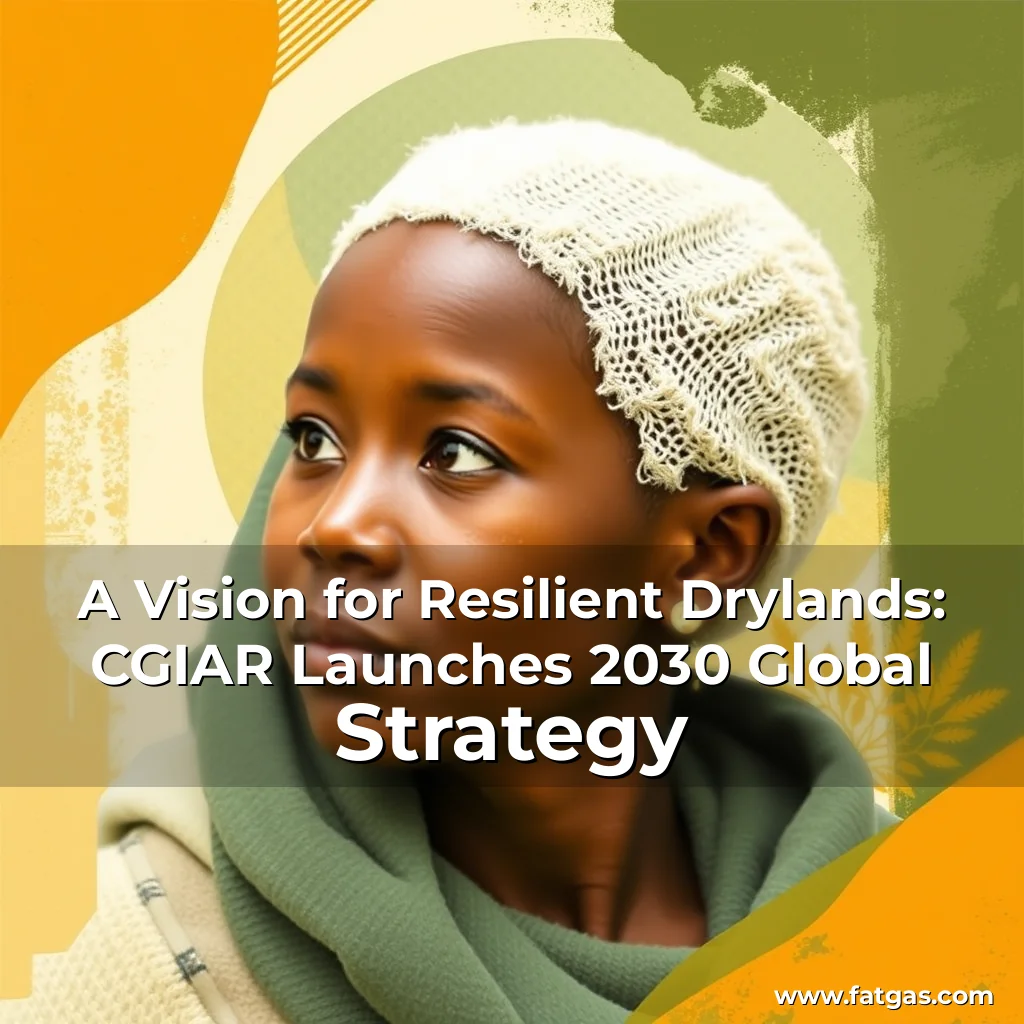
The global agricultural research community has made significant strides in addressing the challenges faced by the world’s driest regions. CGIAR, the leading global leader in agricultural research, has launched its groundbreaking 2030 Global Strategy for Resilient Drylands (GSRD). This visionary roadmap aims to transform farming in these arid zones, ensuring sustainable food systems for generations to come.
Why Drylands Matter
Drylands, long considered fragile ecosystems, play a crucial role in developing climate-smart agricultural models that can be scaled globally. These regions support 44% of global agriculture and nearly half of the world’s livestock. The importance of drylands cannot be overstated, given the 70% of the world’s hungry people living in areas affected by conflict and environmental fragility.
Key Challenges and Opportunities
The GSRD identifies five key opportunities for drylands:
•
- Optimizing agrifood systems to adapt to climate change by developing climate-smart crop varieties, introducing innovative breeding technology, and supporting climate adaptation in livestock and aquatic systems
- Conserving and using biodiversity to support resilient ecosystems and communities by introducing mixed cropping systems, encouraging farming system diversification, and harnessing Indigenous and specifically women’s expertise on biodiversity
- Managing soil, land, and water systems to sustainably intensify production by developing and promoting regenerative and conservation agriculture, facilitating rangeland restoration, and using innovative irrigation technology based on solar-powered agrivoltaics and drip-irrigation
- Ensuring access to sustainable healthy diets to alleviate hunger and malnutrition by promoting nutrient-dense diverse crops such as millets, sorghum, pulses, legumes, roots, nuts, seed and leaves, and animal-sourced foods
- Promoting inclusive, equitable development to nurture safety, agency, and peace
A 50-Year Legacy
Building on 50 years of dryland research, the GSRD leverages innovations from CGIAR’s 15 global research centers and partners. The strategy provides solutions to enhance food security, conserve biodiversity, and build resilient livelihoods by delivering groundbreaking agri-research solutions. Some of these solutions include:
- Solar-powered agrivoltaics
- Innovative agroforestry and livestock feed practices
- Soil improvement and desalination solutions
- Improved breeding technology for climate-smart crops such as barley, lentil, chickpea, soybean or cactus
Regional Impact
The GSRD has the potential to make a significant impact on regions such as Asia and Africa, where 2.7 billion people call the drylands home. According to Dr. Stanford Blade, Director General-Interim of ICRISAT, “Drylands are not just regions of scarcity but immense potential.”
Leadership and Support
The strategy has been developed collaboratively by CGIAR centers under the leadership of ICARDA (International Center for Agricultural Research in the Dry Areas) and ICRISAT. Speaking at COP16 in Riyadh, CGIAR Executive Managing Director Dr. Ismahane Elouafi emphasized the importance of uniting all fifteen centers in a stronger, more integrated effort to tackle the challenges of drylands.
“By combining our expertise, we will deliver more innovative, context-specific, and lasting solutions to secure the livelihoods of communities that rely on these vital but fragile ecosystems,” said Dr. Elouafi.
Conclusion
The GSRD is a groundbreaking effort that addresses the critical challenges faced by drylands. By transforming farming in these regions and ensuring sustainable food systems for generations to come, CGIAR has made a significant commitment to the world’s most vulnerable communities. As Dr.