The Need for Action
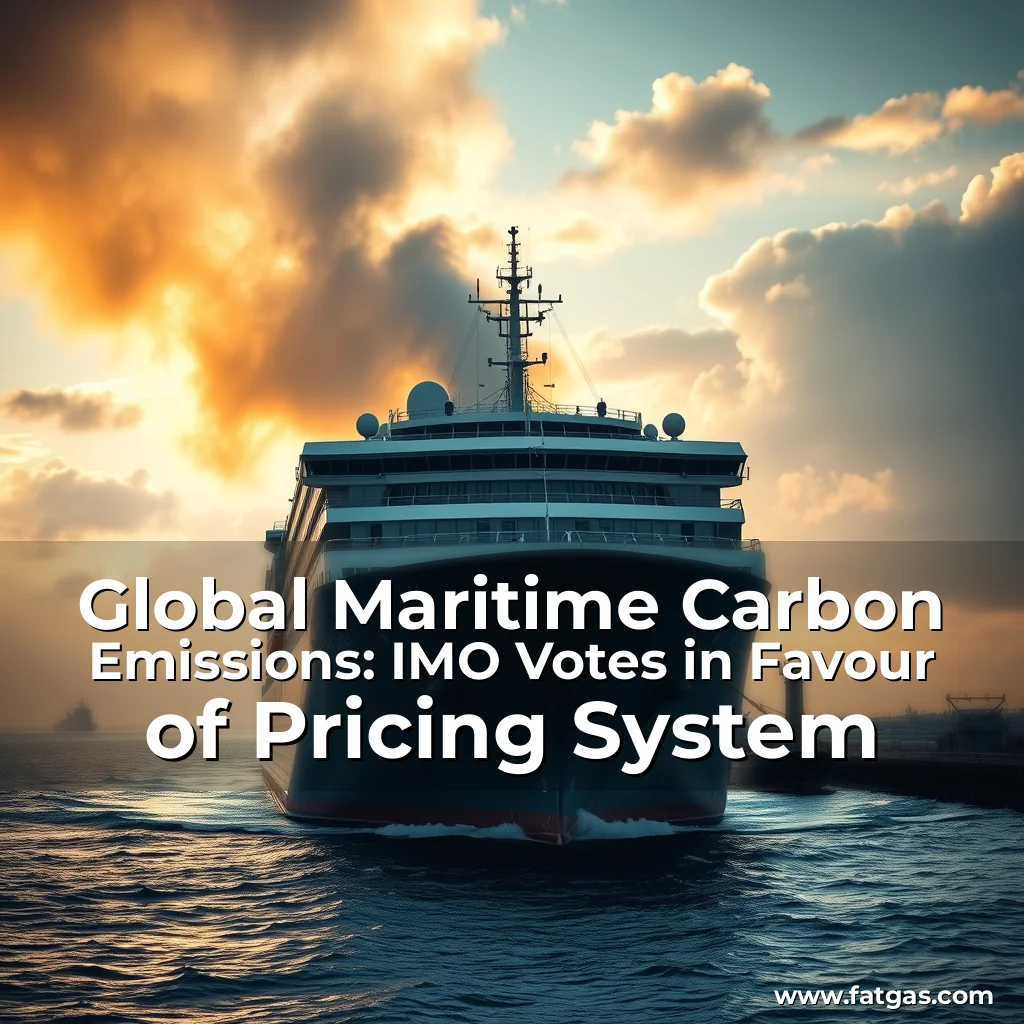
The International Maritime Organisation (IMO) has taken a significant step towards reducing the environmental impact of shipping, with a majority of member states voting in favour of a global pricing system to curb maritime carbon emissions.
Shipping accounts for nearly three percent of global greenhouse gas emissions, with an estimated 100 million tonnes of CO2 released into the atmosphere every year. The IMO has set a target of achieving carbon neutrality in shipping by 2050, and the carbon pricing system is a crucial step towards achieving this goal.
Key Provisions of the Carbon Pricing System
- From 2028, all ships will be required to use a less carbon-intensive fuel mix or face financial penalties.
- The carbon pricing measure must now be formally adopted at an IMO assembly in October.
- The funds raised will be used to “reward” zero or near-zero greenhouse gas emissions technologies and to financially support developing countries to transition to lower-emissions shipping.
The Vote
A total of 63 states voted in favour of the carbon pricing system, including major players like the European Union, Brazil, China, India and Japan. Sixteen states voted against the measure, while 15 Pacific Island states abstained.
- Saudi Arabia, Russia and the United Arab Emirates were among the states that voted against the measure.
- Pacific Island states deeming the proposals insufficient to meet decarbonisation goals.
The Reaction
The Solomon Islands’ minister of infrastructure development, Manasseh Maelanga, expressed disappointment with the outcome, stating: “We cannot support an outcome that does not live up to the agreed strategy.”
A French source noted that the ambition was “not what we had hoped for in terms of trajectory but it is greater than what already exists within the European framework.”
Mark Lutes, senior advisor at the World Wildlife Fund for Nature, welcomed the fact that governments have “understood the need to catalyse and support investment in zero-emission fuels.”
However, he noted that key aspects of the agreement fall short of what is needed, and risk blowing the transition off course. Constance Dijkstra, a policy manager at the Transport & Environment lobby group, expressed concern about the mass production of biofuels, stating that it could lead to “very worrying” deforestation. The International Chamber of Shipping welcomed the fact that governments have “understood the need to catalyse and support investment in zero-emission fuels.”
However, it expressed concern that the agreement may not provide the necessary certainty for shipowners and operators.
A New Framework
The IMO has agreed to create a “control area” in the northeast Atlantic, which limits the use of the most polluting marine fuels around the coasts of Western Europe, Iceland and Greenland.
| Control Area | Description |
| Neighborhood | The northeast Atlantic region, including Western Europe, Iceland, and Greenland. |
| Fuel Limitation | The use of the most polluting marine fuels, such as high-sulfur fuel. |
| Purpose | To reduce greenhouse gas emissions from shipping in the region. |
The Way Forward
The IMO has taken a significant step towards reducing maritime carbon emissions. However, there is still more work to be done to achieve carbon neutrality in shipping by 2050.
The carbon pricing system is a crucial step towards achieving this goal, but it is not a silver bullet. Shipowners and operators need certainty and support to invest in zero-emission fuels.
Quoted Statement from the World Wildlife Fund for Nature
“However, key aspects of this agreement fall short of what is needed and risk blowing the transition off course.” – Mark Lutes, senior advisor at the World Wildlife Fund for Nature
Conclusion
The IMO’s decision to adopt a global pricing system for maritime carbon emissions is a significant step towards reducing the environmental impact of shipping. Shipowners and operators need certainty and support to invest in zero-emission fuels. The IMO has taken a crucial step towards achieving this goal, but it is not a silver bullet.